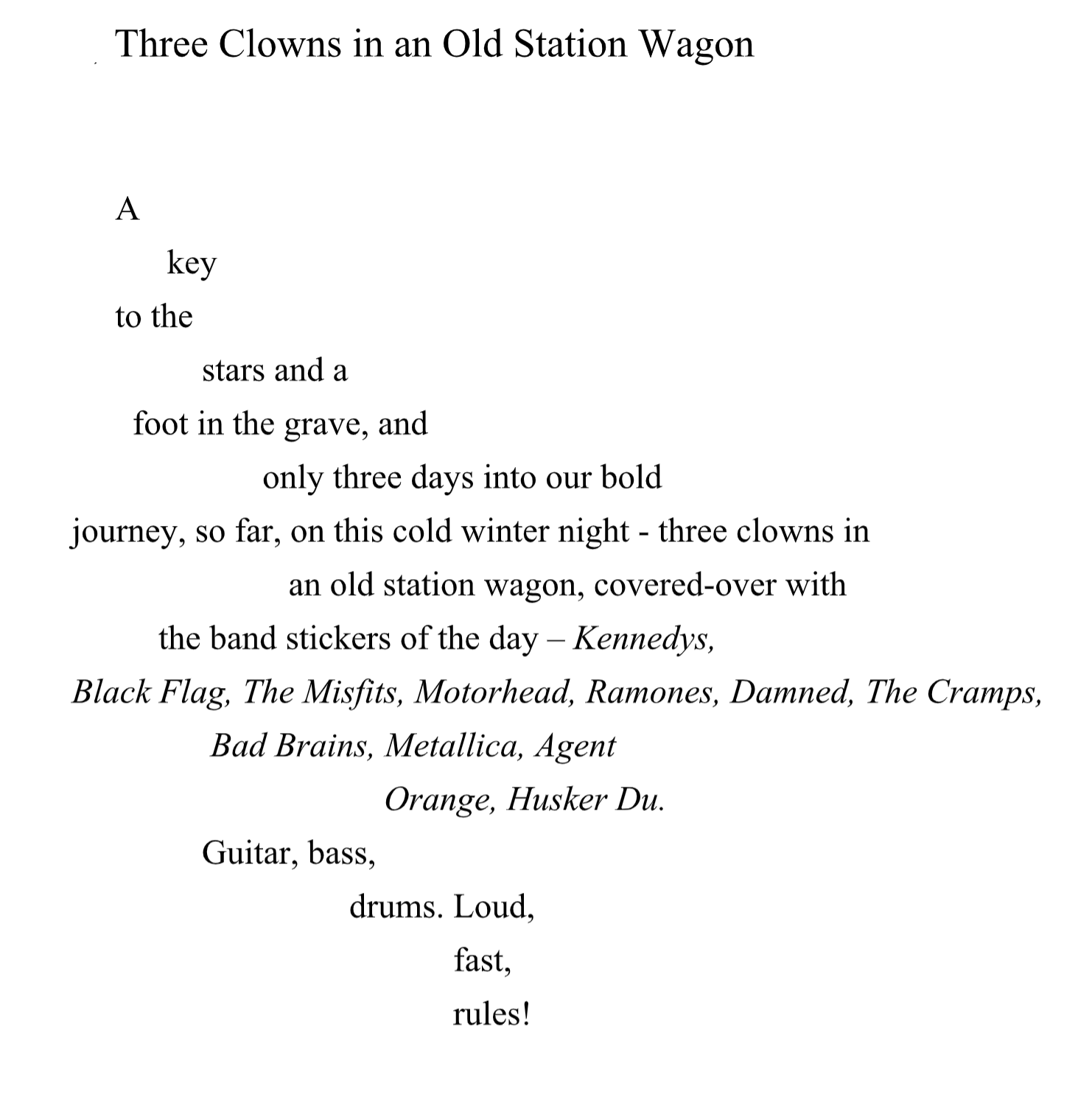
Lorna Wood: “Swimming at Villa Copenhagen”

Swimming at Villa Copenhagen

From the pool I see
sunny blue with only
a few wispy white clouds.

Last night, my tired husband
called the amusement park
“the Frivoli Gardens.”

From its flying swings,
some screaming rings out—
the song of the frivoli.

Alongside my laps,
the businesslike windows
have gone all Magritte blue,

as if the wall were only a shell
holding back the sea
forever and ever,

as if there were another,
world where I would never
have to get out of the pool—

or maybe a world where climate change
only meant the turn of the seasons
and kids could once again ice skate and build snow forts.

I even dream of a Frivoli world
where everyone could swim in this pool
and fly on those swings.


Lorna Wood lives in Auburn, Alabama. Her flash fiction has appeared in Every Day Fiction, Wild Violet, and Every Writer, among others. Her poetry has appeared in her collection, The Great Garbage Patch (Alien Buddha Press), and in many magazines on five continents.

Patricia Nelson: “The Aftersong”

The Aftersong

Something knowing occupies
the sky. A color or a light
that seems to see.
A kind of wish, imperfect
as the gods and monsters that the mind bleeds.
A direction felt like wind.
Perhaps the weather holds it up.
But should that blowing stop
and drop it where we stand
upon our blue, eroding rock, what
would it disturb with its visions
and then its aftersong
which will never be clear
or long enough?
Patricia Nelson is a retired attorney, now happily writing poetry. Her new book, Monster Monologues, is due out from Fernwood Press in the spring of 2025. 

Meghan Rainey: “How To Dance”

How To Dance

When the world starts to end
All I really want is a dance
I’d never confess I’ve had trouble finding my footing but you can tell
When you put on Harvest Moon for a change
“Don’t forget your left foot” you’re saying “Don’t forget your left foot”
I’m still walking backwards, my right hand on your chest
Pull me in tight, harmonica solo
You look so tired of my shit
But still, you kiss my wrist
This kind of apocalypse is nothing like we’ve seen before
Rising salty waters and dangerous forest fires
That’s all right, that’s okay
One foot in front of the other now


Meghan Rainey is an award-winning photojournalist, mass-transit advocate, retired prom queen, and all-around delight. She graduated with a degree in journalism from Shippensburg University in 2020. She is published by Hog River Press and Moss Puppy Magazine in 2024 and is represented by literary agent Laura Bradford. You can find her on Twitter (X), Instagram and Threads (@rhursday on all platforms) or at www.meghanrainey.com


Geoff Sawers: “On the Platform”

On the Platform

It started with his walking her home from church.

Obviously, it didn’t start there, there must have been something before. Physical at that point: he liked her soft grey eyes and slightly breathy voice. He offered to walk her back, and she acquiesced. When they got near to her house she said stop here and he asked her why. I’m just around the corner, she said, and scuttled off.

Things went on like that. People see us leaving church, he said. She shrugged. They took to spending a few minutes on a park bench on the way to chat. Both signed up for a Bible-study weekend away in a converted country house. She wouldn’t sit with him on the coach but once they got there, came to find him at dinner. They joked about it being like an Agatha Christie. After the prayer meeting she said she was tired but he urged her to come out onto the terrace. There was a little summer-house just visible across the lawn in the gloom. It smelt of cigarettes inside, the cooks probably used it, but they opened the doors wide to let the breeze through. They went there the next night too, found some blankets and settled on the broken sofa. She told him about the man her parents expected her to marry; older, a family friend. Do you love him? I suppose so, she answered. Yes, of course. They laced their fingers together and he stroked her arm. How does he make you feel? She sighed and nestled into his shoulder. I don’t know.

She got four As and a place at a top university; he got a college place in a nearby town, and they wrote. He had a thing going with the college’s star athlete, in secret. It was furtive, late-night, one-way: a quiet rap on his door and the guy would come in. He wasn’t allowed to make any move himself but there was a lot of pleasure in it, he let it happen. When she had a study week he went to see her. He wrote saying what time his train would come in and she was there on the platform, stood on tip-toe to kiss him, took him to her room; to both of their surprise they went to bed. Afterwards they couldn’t speak, just lay face to face with their arms round each other. The next day she showed him a letter from her fiancé, all about the house he was buying. Look, she said, he’s asked me what kind of car I’d like. What’s that, he replied. A Mini Mayfair, she said, decidedly. I just think they’re lovely.

Now he opens his eyes, checks the time again, and his texts. In four minutes he will meet a grown-up, and newly-orphaned, daughter. They have swapped messages for weeks; she was surprised to learn that he had a husband, but not put off. He is thinking about the colour of her eyes.


Geoff Sawers (he, him) is the author of several books including a collection of linked short stories, Friends of Friends (Diehard, 2024). He is a full-time parent and lives in Reading, UK.


Jason Ryberg: Two Poems

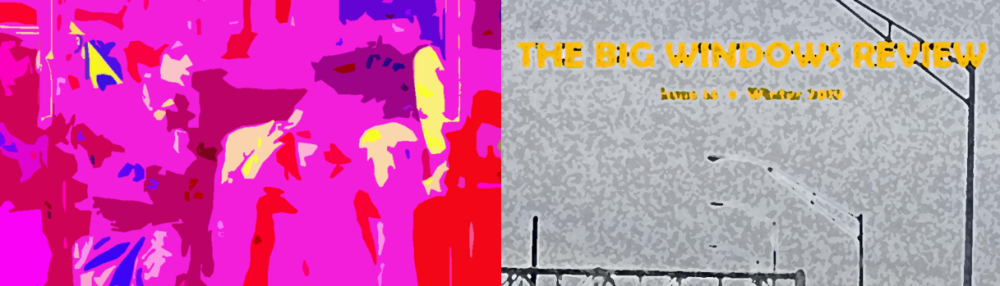
Tin Cup LightningThree Clowns


Jason Ryberg is the author of eighteen books of poetry, six screenplays, a few short stories, a box full of folders, notebooks and scraps of paper that could one day be (loosely) construed as a novel, and countless love letters, never sent. He is currently an artist-in- residence at both The Prospero Institute of Disquieted P/o/e/t/i/c/s and the Osage Arts Community, and is an editor and designer at Spartan Books. His latest collection of poems is Fence Post Blues (River Dog Press, 2023). He lives part-time in Kansas City, MO with a rooster named Little Red and a Billy-goat named Giuseppe, and part-time somewhere in the Ozarks, near the Gasconade River, where there are also many strange and wonderful woodland critters.

Ben Nardolilli: “Ok, Hinge”

Ok, Hinge

Making these voyages to a benevolent somewhere
and looking for a student
of shared incidents so we can exchange notes later

Done with magnificent plunderers and sour darlings,
no lying agents need apply,
the days of relic hunting over, I’m secular towards love

Come partner, slide in front of me and send me a push,
Sit next to me and watch
This film called modern living all the way to the end


Ben Nardolilli is a MFA candidate at Long Island University. His work has appeared in Perigee Magazine, Door Is a Jar, The Delmarva Review, Red Fez, The Oklahoma Review, Quail Bell Magazine, and Slab. Follow his publishing journey at mirrorsponge.blogspot.com.

R. P. Singletary: “Situation beggin for remedy”

Situation beggin for remedy

He loved DJ’in Saturday night bops, could play their favorite tunes and she’d just have to f*ckin dance or else cause a scene by not cuz he knew and she knew she’d caused enough of em already, hell just like him copyin him copyin her copyin him, ya see what I’m sayin, don’t nobody know which looked first to copy what – how even when they were an item all those months back before the baby and the fights really began like nothin they’d ever thought up before or since the grandkids tried to tell em, Y’all too old to dang dance DJ, fool fussin like that, granny gramps git on, but them two?, they just pointed confused twirls of their fingers into their own wizened, aged ears, raised their hands, twitched their shoulders, and kept on dancing, DJ’ing, jerking their wheelchairs, loving their own way until their own silent, sudden end. When they were missed from the moment and our real ruckus began, off-key but celebratory not celibate! celebratin’ new joy their old ways a future, continued, imagined moooves… to their melody, ageless their own watching unawares, only concern for the beat.


A rural native of the southeastern United States, R. P. Singletary is a lifelong writer across fiction, poetry, and hybrid forms and a budding playwright with recent fiction, poetry, and drama published or forthcoming in Litro, BULL, Cream Scene Carnival, Cowboy Jamboree, Rathalla Review, The Rumen, Wasteland Review, The Wave – Kelp Journal, the coalition (Coalition for Digital Narratives), Roi Fainéant Press, en*gendered, Wicked Gay Ways, House of Arcanum, The Collidescope, Ancient Paths Christian Literary, EBB – Ukraine, Pink Disco, D.U.M.B.O. Press, and elsewhere. Member, Authors Guild and Dramatists Guild. Websites:
insta / twitter: rpsingletary

David A. Goodrum: “In the Storm”

In the Storm


David A. Goodrum is the author of Vitals and Other Signs of Life (The Poetry Box) and Sparse Poetica (Audience Askew). Recent publications include Tar River Poetry, Gyroscope, San Antonio Review, I-70 Review, Cirque, Banyan Review, Tampa Review, among others. David lives in Corvallis, Oregon. See more at www.davidgoodrum.com.

Roger Singer: “East River”

East River

under a misty
overcast with
threatening rain
as waves slap
stained walls
while traffic
jams and jives
north, south
around
and over
with constant
over reaching
turbulent noise
broadcasting the
language of
a city breathing
in and out


Dr. Roger Singer is the Poet Laureate of Old Lyme, Connecticut. He has had over 1,000 poems published on the internet, magazines, and in books and is a 2017 Pushcart Prize Award Nominee. He is also the President of the Shoreline Chapter of the Connecticut Poetry Society.

William Teets: “An Opera of Silence”

An Opera of Silence

How can I forget my madness if I’m mad
How can I erase the daughters crying
in nighttime summer rain
after their fathers and uncles and lovers and brothers
are gunned down by five-o for hustling
8-balls beneath the El
to rich white bored boys from Scarsdale

How can I forget my madness if I’m mad
How can I erase Donna’s memory
so she’ll forget I smashed a beer bottle
through the picture plate window at Paradise Inn
pushed her too hard into the long grass
behind the Viking Boat Yard
held her tight to my chest as she shook
with sobs soft like river fog

How can I forget my madness if I’m mad
How can I erase words that scream
out they are poems
when the best verses hide
behind veiled remorse of fear and failure
at 183 rd and Tremont
the Hudson River
and alone in my room

How can I forget


William Teets is a writer born in Peekskill, New York, who has recently relocated to Southeast Michigan. He misses New York pizza, the Hudson River, and Fran, Remember the Good Times ‘68.  A collection of his poetry, After the Fall, was published by Cajun Mutt Press in February 2023.