Carolina Marchioro: “Litany for a Childhood Stranger”

Litany for a Childhood Stranger

I know we’re only two drinks in but
I really wish you’d fall apart on me now.
Our bodies are sticky and warm like when
we were kids and fell asleep on the couch
just waiting in the dark for your mom
to carry us to bed. Fall apart on me in a
I want to tell you a secret kind of way
in a I’m still afraid of the dark kind of way
in a I never really loved him kind of way. I’ll
tell you something back, like how
I keep dreaming about the freckles on your hip.
What’s a party if not a confessional?
This balcony has heard more sins
than the Hagia Sophia. Have another shot,
shoot me too while you’re at it.
Let’s absolve each other or worship
each other or kiss like we’re praying
which is a little embarrassing in this day and age but
no one is watching us anyway.

Here’s the thing – I don’t care that you stole
my bra or stole your brother’s vodka
or stole some boy’s undeveloped heart.
I don’t care that you mistook Gandhi for a feminist
novelist or mistook my averted gaze
for envy. I’ll still make a museum for you
out of this cigarette, sticky with our overlapping
lip gloss stains. Isn’t this why we go to parties?
Put your arm around me. Let’s watch people
search for the kind of knowledge I learned
when we were twelve, when we practiced kissing
in your bedroom, two days before you
discovered boys. The kind of knowledge
some people have to take drugs in Bali to get
some people have to hold their head underwater
or get lost in the desert or walk over icecaps
or pretend nature is a mother and the universe
is a lover, waiting to soothe us into the order of things.

Look – someone’s regurgitating candy-apple
ultraviolet bile into a red-tailed comet
on the hardwood floor. It’s streaking towards us,
maybe announcing the falling of an empire
or the coming of a messiah. Which would you prefer?
Look – the cigarette’s become impressionist embers
painted on the soles of my Doc Martens. Your phone
is singing surly messages; wtf where’s my vodka??
I’m telling mom. This story has two endings
but I don’t have the conviction to write
the second one in. You ignore the phone,
turn away from the vomit comet, release
my aching waist. The shape of your voice
falls away from me like the time we tried skipping
stones and they all sank straight to the bottom
of the lake. You never did tell me that secret
but I’ll say a Hail Mary anyway, just in case.


Carolina Marchioro is a queer writer and a student at the International Writers Collective in Amsterdam. Her poetry has previously appeared in the Loss anthology by Pure Slush, among others. Originally from Rio de Janeiro, Brazil, she was drawn to the culture and energy of Amsterdam, where she’s resided for the past two years. 
Peter J. King: Two Poems (with Photographs by Mike Roberts)

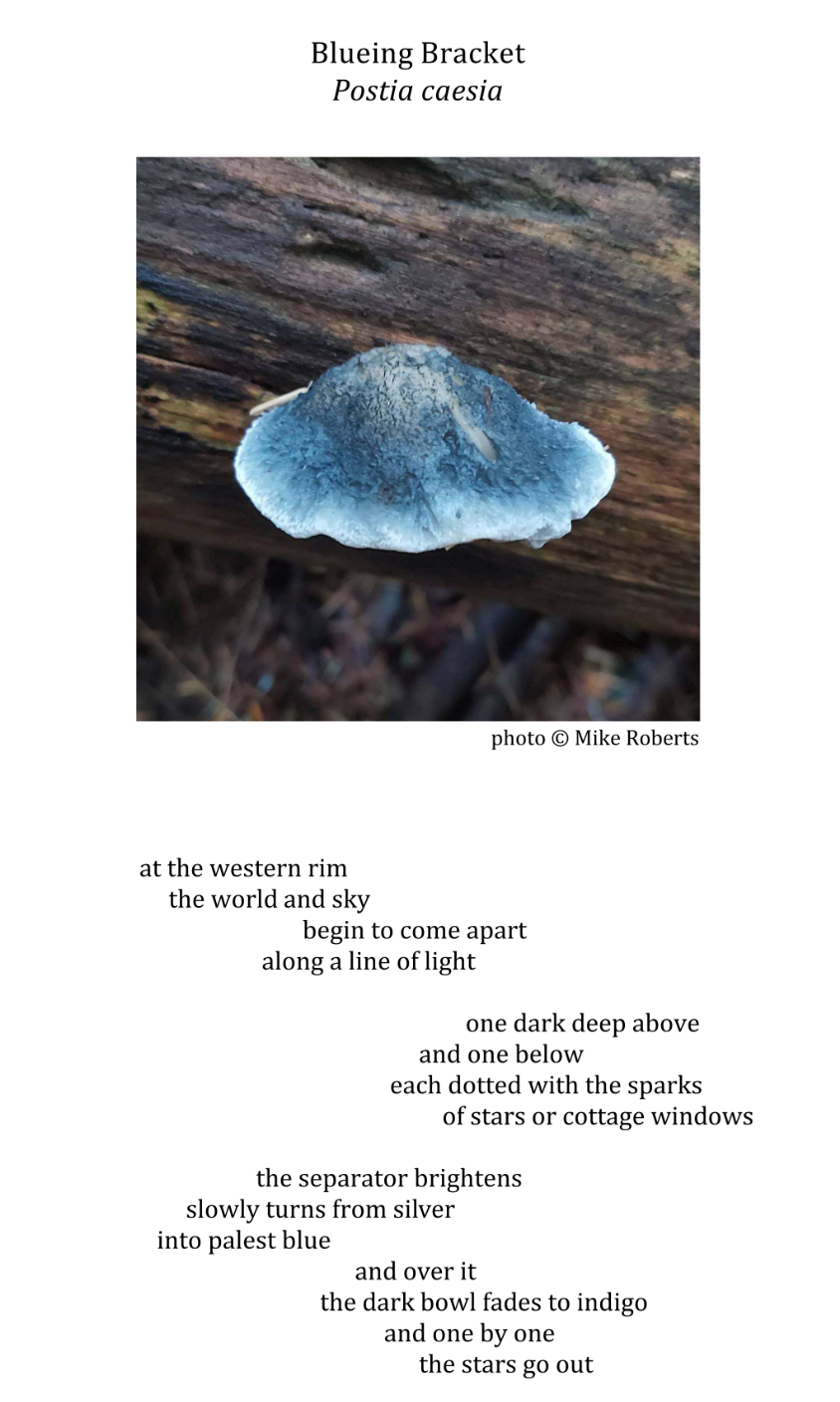
Blueing Bracket

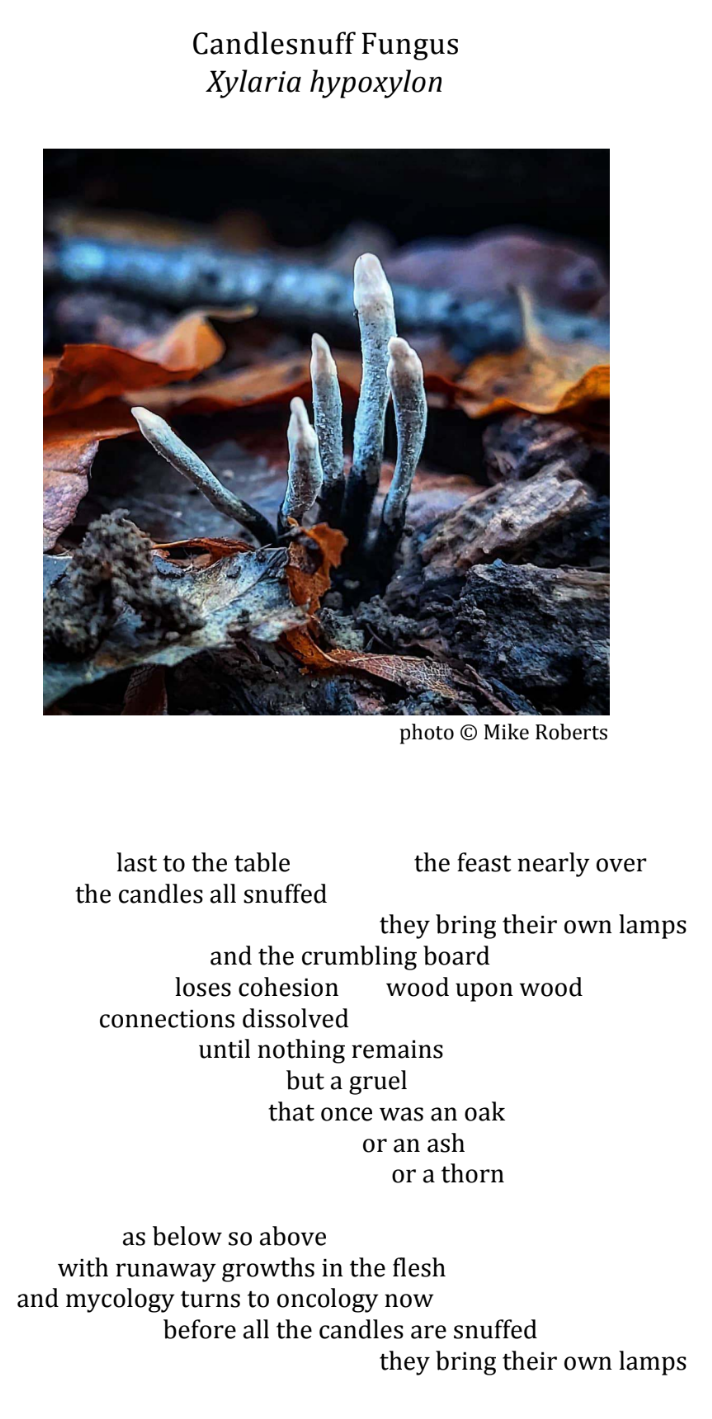
Candlesnuff Fungus


Peter J. King, born and brought up in Boston, Lincolnshire, now lives in the Oxfordshire Cotswolds. His poetry, short fiction, translations (mainly from modern Greek and German), and paintings have been widely published in journals and anthologies. His most recent poetry collection is Ghost Webs (The Calliope Script, 2022).
https://wisdomsbottompress.wordpress.com/peter-j-king/

Mike Roberts is a self-proclaimed fungi enthusiast from North Wales. His passion is to showcase in his photographs the unique fungal diversity around him, with the aim of discovering and recording the large variety of species that he is fortunate enough to find in his small area of the world.

Ben Macnair: ‘Modern Magic”

Modern Magic

I don’t believe in Witchcraft,
or in Voodoo Dolls,
and if anyone here knows
Psycho-kinesis, please
raise someone else’s hand.

I don’t believe in Leeches
being a cure for everything,
or how a lock of someone’s hair
can tie you to them forever.

I do believe in conversation,
in connection, in secrets,
in parks, and happenstance,
and how modern magic happens
without any real effort.

I do believe in team work,
of egos being put aside,
of the loud being told to be quiet,
and really listening.

I do believe in change,
and being open to the world,
for the magic is in the ever changing weather,
the spider always rebuilding their web,
and things outside of knowledge,
before the Internet, the tribalism
the echo chamber.
The birds, still singing,
welcoming the warmth of a newly risen sun.


Ben Macnair is an award-winning poet and playwright from Staffordshire in the United Kingdom. Follow him on Twitter @ benmacnair

paul Bluestein: “Flight”

Flight        

As the new year began, you took flight
from this world and left me in it.
Alone.
The day that had come up like a sheet of rolled iron
turned dark,
like the lights that go down in a theater
when the interval is over
and the last act is about to begin,
or when daylight slips into dusk,
the birds go quiet
and the mouse of doubt gnaws at you.
Once, I imagined I would never lose my way.
Now I’m searching in a dark and unfamiliar room
for a switch that can bring back the light.
I may find it someday…
but it won’t be today.


paul Bluestein is a physician (done practicing) and a blues musician (still practicing). He lives in Connecticut near a beach where he finds quiet time to think about the past, and wonder about the future. In addition to poems and short stories that have appeared in a wide variety of online and print publications, he has had two books of poetry published – TIME PASSAGES in 2020 and FADE TO BLACK in 2021.

Ken Meisel: “Bill Spencer’s Car Lot, Route 89, Glendale, Utah”

Bill Spencer’s Car Lot, Route 89, Glendale, Utah 

_____“Everyone who humbles himself will be exalted” – Jesus Christ

My wife and I drive up on it, Bill’s Car Lot, route 89
in Glendale, Utah. We’re trying to get to Bryce Canyon

but this lot, this festival of cars, interrupts all that. 
It’s a palace chamber of old cars, fixed like gravestones.

Blackjack oak and juniper crest the tough landscape, color
the rocky ridges. Piles of rubber tires climb up slope.

It’s the 69’ Mercury and the 59’ Edsel out front that stop us.
But nothing here at all seems dead; every car’s alive. 

So is Bill, hiding there in his truck, cracked smile, eyes
like stars, like fluorite, like desert candles and skin so

brown and leathery it makes you want to run a wet cloth
across it to moisturize it – until you see he’s so fresh, so alive

with mission, with conviction, with a reverence for life
among these cars, these old death-bringers that arise in life.

On the radio, America’s “Lonely People” is softly playing. 
And then Steely Dan’s “Bodhisattva” chugs spunkily on. 

The clouds above us, thick as cauliflower, the blue sky
hovering over rock ridges, the dirt, dry as bone. Bill’s

reading in a truck. Gets out, welcomes us as we greet him 
at his 57’ Chevrolet. Invites us to go ahead, walk around,

everyone’s welcome here. Out back, in the car pasture,
we see a 57’ Fairlane, a 69’ Pontiac Bonneville, a 63’ Ford

Galaxie 500 drowning in scrub. We see a 55’ Olds, a
74’ Pontiac Parisienne, fudge brown with rust, and a 64’ 

Dodge Dart, light Blue, eyeless, its rear trunk wide open.
Bill says the 63’ Chevy is one of his favorites: he drove

it to Vegas to meet his brother there. And then he drove
the 67’ Chevy to California to choose a baby boy, Dave, 

for adoption. His wife died in 99’… Bill’s in tears now,
my wife and I close beside him as his oratory of life, his

small confession of loss, plays on. He says there are
places men shall bring life to the heart-torn world, and in

those places they shall hear the voice of our healing. Says
I can save a lot, but not in death: after a girl was born and

then passed over into angel-fire, after only 75 short minutes
of life, he and his wife decided they needed a boy, a son.

Bill was cutting logs for the mills when a girl, out west,
birthed a little baby boy and there it was, the sign: He’d

ready himself to drive out and get him. My boss knew it:
gave me a Christmas bonus. The kindness of it. And then he 

says, we’re born into a world to make something of it, or else
greed ruins everything. And says, that’s the death of love, sweet 

love. My wife moves under his left arm as he tells all this;
he pulls her to him and I see the last hours of the Christian

era passing through his eyes. He pulls her close, thanks her
for spending her time in an old man’s company. And me, too. 

Why is it we hug him so close? He’s a Utah bodhisattva,
and Bryce Canyon can go straight to hell. We’re spending

our time with him right now. He says a boy in Spain writes
him every year, calls him Papa; and that the visit here, 

all those years ago, made them ancestors, drops of rice
in a bowl that is the grain that makes a living crop alive.

Says, It’s a car lot, not a junkyard. Teaches kids how
to get value out of a car; some kids get a car and then

get rid of it right away; they don’t know how to get
the value out of it; you have to know how to get the

value out of it . . . and we didn’t get to where we are, he
says to her and me, without people like you, and me.


Ken Meisel is a poet and psychotherapist from the Detroit area. He is a 2012 Kresge Arts Literary Fellow, Pushcart Prize nominee, best of the net nominee, winner of the Liakoura Prize and the author of nine poetry collections. His new book, The Light Most Glad of All, was published in 2023 by Kelsay Press. He has work in Crab Creek Review, Concho River Review, San Pedro River Review, Panapoly, Sheila-Na-Gig, and The MacGuffin.


john sweet: “poem for the vast distances that we will die trying to cross”

poem for the vast distances that we will die trying to cross

got yr husband and yr ex and yr
child and do you remember
that i was the prophet of all your wasted years?

do you understand you’re
the ghost of mine?

and it’s early afternoon on some
bitter grey sunday and
i’m not nearly drunk enough, and i still
have the letter where you told me you forgave me,
and i hope you still have the one where i
told you to fuck off and die

and i hope you’re all right

i hope we’re both still immortal

i’m pretty sure i need to see you
at least one more time


john sweet, b 1968, still numbered among the living in upstate NY. A believer in writing as catharsis. Opposed to all organized religion and political ideologies. His latest collection is BUT I REMEMBER THE FUTURE BECAUSE IT ALL TURNED OUT WRONG (2024 Alien Buddha Press).

John Grey: “Somewhere in Iowa”

Somewhere in Iowa

Sure, the drive’s monotonous
but you can’t eat scenery.
Grain has to grow somewhere
and the Midwest is where it chose.

The roads are straight, flat,
and lined with fields 
of corn, soybeans and rye.
It’s no place for trees.
The few that remain 
cluster around farm-houses.

I pass by the occasional 
man of the land
high up in a tractor’s saddle.
Half wave,
half go about their business.
No city I know
could come close to fifty percent.


John Grey is an Australian poet, US resident, recently published in New World Writing, North Dakota Quarterly, and Lost Pilots. Latest books, Between Two Fires, Covert, and  Memory Outside The Head are available through Amazon. Work upcoming in California Quarterly, Seventh Quarry, La Presa, and Doubly Mad.


Russell Rowland: “The Whole Point”

The Whole Point

In the north country each road downtown
seems to head you toward one mountain or another,
as if the whole point

of settling a town was to build roads that take you
to this trailhead or that—

as if the advantage of living here at all
is the chance to view your aspirations from higher up.

Many villages have a steeple making the same point.

Show me someone killing time
downtown, who says, “What’s in it for me,” or even
“If I can’t have her, nobody will,”

or “go back where you came from”—
I’ll show you someone who isn’t strong into climbing.


Russell Rowland writes from New Hampshire, where he has judged high-school Poetry Out Loud competitions. His work appears in Except for Love: New England Poets Inspired by Donald Hall (Encircle Publications), and Covid Spring, Vol. 2 (Hobblebush Books). His latest poetry book, Magnificat, is available from Encircle Publications.

Joe Giordano: “True Love Never Did Run Smooth”

True Love Never Did Run Smooth

I loved Adriana. Picturing her chocolate mane, blazing hazel eyes, and ruby mouth, I’d arrive at her apartment, heart galloping with anticipation. We’d grasp frantically, tumbling onto the floor as we caressed before I carried her to the bed where we’d make love as the setting sunlight poured through her bedroom window, giving her body a golden glow. We didn’t think about food until midnight. 

Torrid months led to hints about commitment, which I deflected. My passive attitude was countered with random digs. Criticisms, I understood, which reflected her frustration, but, even so, the pressure made me uncomfortable.

Why did I cheat? Because a young, flirty thing gave me the eye? Subconsciously, did I want to punish Adriana for her jibes? Regardless, my ego trumped good judgment, and although I immediately regretted my decision, I had no “do-over” for a bad choice. My self-loathing made me careless, like I wanted to be punished. Adriana saw my lover’s explicit text and she exploded. I protested that a one-night stand meant nothing, but Adriana couldn’t be calmed. Vitriol spewed out of her. She accused me of crushing her feelings, then tossing her aside without conscience or regret. 

The pistol she produced shocked me frozen, my attention riveted on a black-cavern barrel, my body becoming dank with putrid sweat. She held fire, and I hoped she was reconsidering, not enjoying my fear. I begged for mercy as my mind flipped through a rolodex of images, searching for words that would assuage her.  

The sting of the gunshot burned, and I grasped my chest, my shirt slimy wet. Adriana’s hand caught a sob before she turned and ran. Collapsing to the ground, I lay in a copper-smelling pool of my own blood, staring at a cloudy sky, feeling my heartbeat in the wound, smelling asphalt and gun smoke. 

I realized I was dying, and surprising thoughts of forgiveness entered my head. I cheated. Adriana felt deeply betrayed. Shooting me was justice. 

She hadn’t dropped the pistol. There were no witnesses. She might be suspected, but if she kept her nerve, nothing could be proved, and she’d stay free. But she couldn’t just get on with her life. Killing me was a grave act. Her conscience would plague her, and her immortal soul was in jeopardy. If I really loved Adriana, I must give her the opportunity for repentance and redemption. As my life ebbed away, I panicked over how I could help her, until it came to me. The authorities would see to it. As an act of true love, I smeared my blood onto the sidewalk spelling the words, “Adriana killed me.”


Joe Giordano’s stories appeared in The Saturday Evening Post, and Shenandoah, plus his short story collection, Stories and Places I Remember. His novels include Birds of Passage, An Italian Immigrant Coming of Age Story, and the Anthony Provati thriller series: Appointment with ISILDrone Strike, and The Art of Revenge.

http://joe-giordano.com/